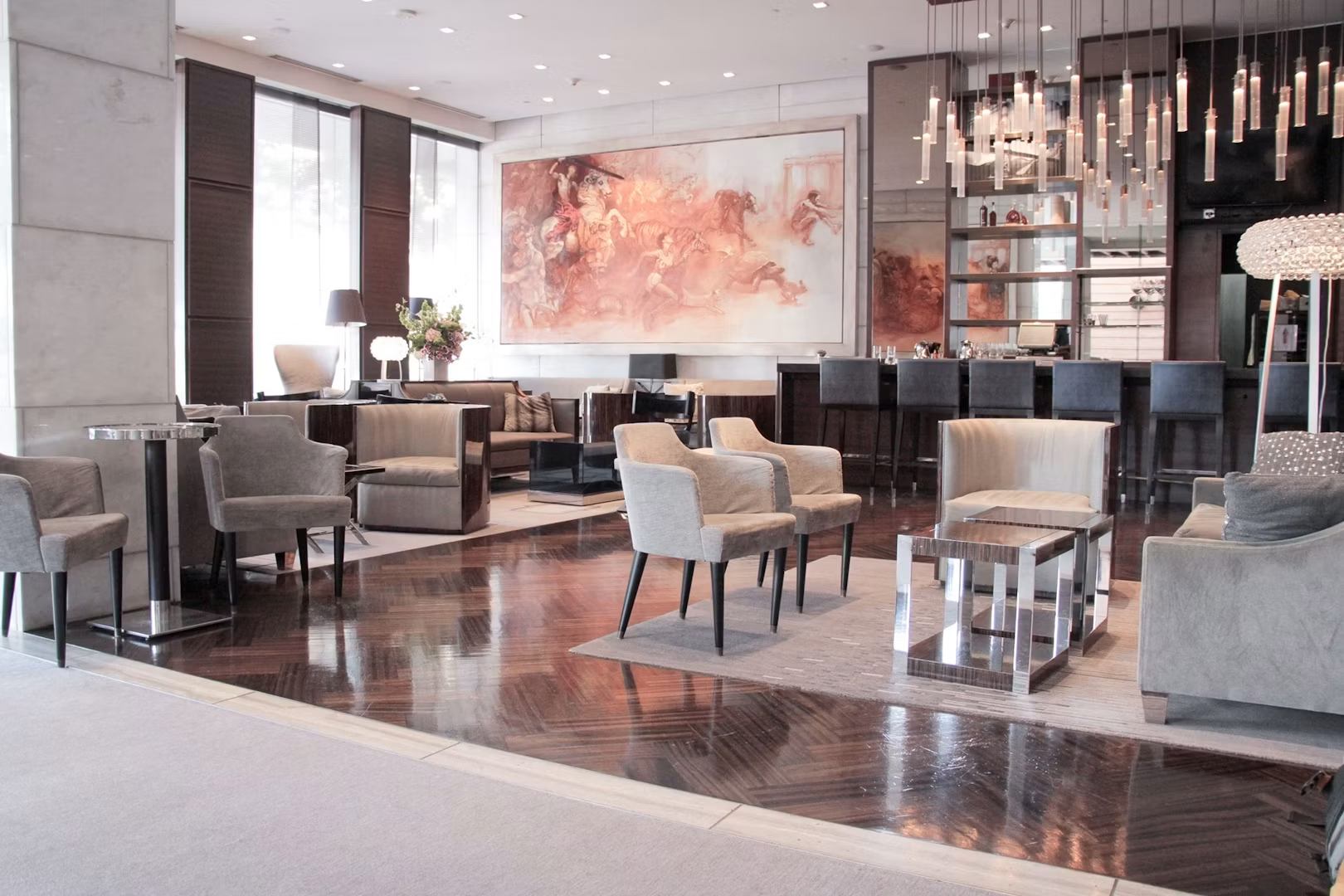
Exotic Business Hotels USA: Definitive Guide to Unique Stays
Modern corporate mobility has transcended the clinical sterility of standard downtown business towers, prompting organizations to seek out distinct environments that stimulate strategic thought and executive alignment. The intersection of high-end corporate programming and unconventional architectural environments defines the contemporary landscape of professional hosting. Rather than resigning executive boards and high-value client summits to predictable glass-box conference centers, corporate strategists increasingly leverage properties that merge uncompromising enterprise utility with radical regional distinctiveness.
Navigating this niche demands a careful reconciliation between operational necessities—such as enterprise-grade network security, audiovisual infrastructure, and ergonomic workspaces—and properties distinguished by unusual geographies, historic adaptive reuse, or avant-garde design. Fusing intense professional utility with remote mountain lodges, desert minimalist enclaves, or restored industrial monoliths creates unique operational friction points. Organizations that master these environments unlock immense cultural and strategic dividends, while those treating unique spaces as mere backdrops frequently encounter severe logistical bottlenecks.
This reference manual establishes an exhaustive structural framework for identifying, evaluating, and managing unconventional corporate lodging properties across domestic markets. By dissecting architectural trade-offs, connectivity redundancies, specialized procurement hurdles, and long-term risk governance, this guide serves corporate travel directors, executive teams, and organizational planners seeking absolute structural mastery.
Understanding exotic business hotels usa

Decoding what constitutes operational excellence regarding exotic business hotels usa requires examining the tension between novel sensory environments and rigorous corporate infrastructure requirements. A premier evaluation framework bridges the gap between marketing aesthetics and functional execution. Assessment protocols must measure dedicated broadband bandwidth, acoustic privacy in unconventional meeting spaces, local supply chain reliability for executive catering, and emergency evacuation protocols in remote or topographically complex landscapes. Planners frequently overlook these foundational baselines when fixating entirely on visual novelty or architectural distinction.
A persistent administrative oversight involves assuming that high-cost, design-forward properties inherently possess the robust digital backbones required for modern enterprise operations. A remote desert eco-resort or a historic mountain timber lodge may offer profound creative inspiration while simultaneously suffering from satellite latency bottlenecks, insufficient power distribution grids, or absolute dead zones for mobile cellular backup. True competence in this domain requires conducting rigorous technical site audits before booking high-stakes executive retreats or board summits.
Contemporary enterprise governance demands absolute continuity, regardless of how unconventional or geographically isolated a property may be. Organizations housing traveling executives require verified failover networks, dedicated breakout rooms insulated from leisure guest traffic, and clear contractual agreements guaranteeing service-level agreements. Recognizing these non-operational compromises prevents enterprises from absorbing catastrophic communication failures, ensuring that every unique lodging selection actively protects executive productivity.
Deep Contextual Background and Evolution of Unique Corporate Lodging
The evolution of unconventional enterprise lodging reflects broader shifts in corporate culture, remote work proliferation, and the commercial real estate sector over the past century. During the industrial era, corporate travel was governed by strict functional utility. Business leaders traveled exclusively to major urban financial hubs, residing in standardized, monolithic high-rise hotels designed to maximize room density and provide uniform corporate amenities.
As the corporate economy transitioned toward knowledge-creation, technological innovation, and creative enterprise during the late twentieth century, organizational philosophies regarding executive offsites and board retreats shifted. Corporations began recognizing that routine environments generated routine strategic outcomes. This realization sparked early experiments in hosting leadership teams at historic country inns, high-altitude alpine resorts, and remote coastal retreats. However, these early initiatives were frequently plagued by infrastructural incompatibilities, including poor telephone connectivity, lack of presentation technology, and severe catering limitations.
In recent years, the convergence of high-speed satellite communications, cloud computing architectures, and a booming market in bespoke boutique hospitality has transformed the category. Modern properties deliberately engineered for hybrid leisure and high-level enterprise utility have emerged across diverse American landscapes—from restored desert compounds in the Southwest to coastal architectural masterpieces in the Pacific Northwest. Understanding this historical trajectory clarifies why legacy procurement models fail when applied to unconventional properties, reinforcing the necessity of specialized structural evaluation.
Conceptual Frameworks and Mental Models for Unconventional Properties
Isolating world-class strategies for managing corporate stays in non-traditional properties requires deploying rigorous analytical mental models.
1. The Isolation and Bandwidth Vector
This model evaluates the inverse relationship between geographic seclusion and digital infrastructure integrity, allowing travel managers to identify latency risks and provision cellular failovers before arrival.
2. The Spatial Friction and Focus Matrix
This framework maps open-concept architectural layouts against the acoustic and privacy demands of confidential board meetings, preventing intellectual property leakage in visually transparent public spaces.
3. The Supply Chain and Service Resilience Index
This mental model measures a remote property’s distance from major metropolitan distribution hubs against its ability to handle customized executive catering, medical emergencies, and last-minute technical repairs.
Analytical Limitation: Mental models provide structural frameworks but cannot fully predict sudden microclimate weather shifts or localized utility grid failures, serving instead as sophisticated baseline instruments.
Key Categories, Variations, and Operational Trade-Offs
Unconventional business lodging environments across the United States span several distinct architectural and geographical categories, each presenting specific structural vulnerabilities and management trade-offs.
| Property Category | Primary Architectural Profile | Core Corporate Advantage | Primary Strategic Trade-Off |
| High-Desert Minimalist Compounds | Isolated concrete, glass, and steel structures integrated into arid landscapes. | Unmatched creative isolation and profound visual inspiration. | Severe vulnerability to extreme thermal shifts and localized power fluctuations. |
| Historic Adaptive Reuse Estates | Restored 19th-century industrial mills, lighthouses, or former convents. | Deep historical character and unique breakout environment layouts. | Suboptimal acoustic insulation and rigid historic preservation rules. |
| Remote Mountain Timber Lodges | Heavy timber and stone structures nestled within high-altitude ranges. | Immersive nature access and strong team bonding dynamics. | Extended emergency response times and limited ground transit options. |
| Coastal Eco-Resorts and Pontoons | Elevated stilt structures and low-impact pavilions over marine biomes. | Tranquil sensory environments and distinct executive positioning. | High susceptibility to maritime weather events and salt-air corrosion of tech gear. |
| Architectural Vineyard Estates | Working agricultural compounds featuring ultra-modern minimalist villas. | Integration of high-end gastronomy and private boardroom facilities. | Distraction risks associated with active agritourism and wine production. |
| Urban Industrial Conversions | Refurbished warehouses and former manufacturing plants with raw steel. | Centralized urban access paired with avant-garde aesthetic styling. | High ambient noise levels and shared public zoning complexities. |
Decision Logic for Property Selection
Travel directors sequence unconventional property selections based on the precise objective of the corporate gathering. For highly confidential intellectual property strategy sessions, isolated high-desert compounds offering total visual and acoustic privacy represent the optimal choice. Conversely, for client-facing executive incentive trips, architectural vineyard estates combining luxury hospitality with curated gastronomy offer superior relationship-building dynamics.
Detailed Real-World Deployment Scenarios
Examining how unconventional lodging properties perform under operational pressure reveals recurring friction patterns that glossy architectural portfolios routinely obscure.
Scenario A: The Remote Mountain Connectivity Crisis
-
Context: A software engineering leadership team books a secluded timber lodge in the Rocky Mountains to conduct a three-day strategic roadmap alignment session.
-
Constraints: The property relies on a single residential-grade fiber line routed through a winding mountain pass, and a heavy early-season snowstorm severs the physical cable.
-
Failure Modes: The lodge loses all internet connectivity and backup satellite systems fail due to heavy cloud cover, instantly halting access to cloud-based code repositories and virtual board presentations.
-
Second-Order Effects: The executive team spends forty-eight hours stranded without digital tools, forcing an emergency relocation to a suburban business hotel and derailing the engineering schedule by a full quarter.
Scenario B: The Acoustic Transparency Breach
-
Context: A venture capital partnership rents an ultra-modern glass-walled desert compound in Arizona to deliberate confidential seed-funding allocations.
-
Constraints: The property features an open-plan structural design with polished concrete floors and floor-to-ceiling glass partitions that completely lack acoustic dampening.
-
Failure Modes: Sensitive financial discussions conducted in the main lounge echo clearly into adjacent common areas occupied by external resort guests and hotel staff.
-
Second-Order Effects: Confidential term sheet details are inadvertently exposed, creating severe legal liabilities and forcing an immediate halt to sensitive discussions.
Planning, Capital Allocation, and Resource Dynamics
The financial architecture of executing corporate retreats in unconventional properties involves specialized contract negotiation, secondary tech provisioning, and hidden opportunity costs.
| Expenditure Classification | Typical Budget Allocation (%) | Direct Budgetary Elements | Indirect / Hidden Risk Elements |
| Property Buyouts and Premium Lodging | 45% – 55% | Exclusive-use property fees and luxury nightly rate allocations. | Strict non-refundable deposit terms and heavy attrition penalties. |
| Redundant Telecom & AV Provisioning | 15% – 20% | Satellite internet kits, dedicated cellular routers, and onsite AV tech rentals. | Complex hardware integration challenges with legacy property wiring. |
| Specialized Ground Logistics & Security | 15% – 20% | Private shuttle fleets, helicopter transfers, and private security details. | Weather-dependent transit delays and high insurance surcharges. |
| Custom Catering and Culinary Support | 10% – 15% | Dedicated private chefs, dietary compliance, and remote kitchen rentals. | Supply chain delivery failures in geographically isolated regions. |
Opportunity Costs and Variability
Opting for ultra-exclusive, remote properties without verifying emergency medical evacuation routes introduces devastating human and financial opportunity costs. If a senior executive experiences an acute medical emergency hours away from a fully equipped trauma center, the resulting crisis completely overshadows any strategic value the retreat was intended to generate. High-performing organizations treat risk mitigation as an absolute prerequisite when exploring unconventional geography.
Operational Tools, Support Systems, and Technological Infrastructure
Executing flawless corporate operations in non-traditional environments requires an advanced toolkit of mobile infrastructure, backup systems, and digital management utilities.
-
Portable Satellite Broadband Units: High-throughput satellite kits providing independent high-speed internet connectivity in remote wilderness locations.
-
Encrypted Mobile Collaboration Suites: Secure, decentralized communication channels operating independently of local property Wi-Fi networks.
-
Remote Property Technical Audit Checklists: Comprehensive digital assessment forms evaluating local power grid stability, generator capacity, and bandwidth throughput.
-
Private Aviation and Ground Tracking Portals: Real-time logistics platforms coordinating complex multi-vehicle executive transit schedules in isolated regions.
-
Acoustic and Spatial Mapping Software: Digital interior planning tools assessing meeting room privacy and sound attenuation before booking.
-
Emergency Medical Response Integration Systems: Platforms linking remote retreat coordinators directly to regional medical evacuation networks.
Systemic Limit: Technological infrastructure cannot overcome severe physical isolation. If a severe natural disaster closes all surrounding access roads, even the most advanced satellite setup cannot facilitate physical departures.
Risk Landscape, Failure Modes, and Compounding Cascades
The risk profile of managing corporate programs in unconventional properties is defined by compounding vulnerabilities where an initial environmental misstep triggers cascading operational failures.
Taxonomy of Unconventional Venue Risks
-
The Infrastructure Single Point of Failure: Total reliance on a remote property’s fragile local electrical or water utility grid without industrial backup generators.
-
The Confidentiality Vacuum: Architectural choices prioritizing aesthetic transparency over physical and acoustic security, leading to corporate espionage risks.
-
The Logistical Bottleneck: Geographic isolation preventing timely delivery of essential business supplies, catering goods, or technical replacement parts.
-
The Regulatory Compliance Blind Spot: Selecting boutique properties that lack ADA compliance, commercial fire safety certifications, or proper zoning permits.
Compounding Failure Cascades in Practice
Consider a multinational financial conglomerate hosting an executive summit at a historic island estate off the New England coast. A severe coastal nor’easter strikes on the second day of the conference, knocking out the island’s main power grid. The estate’s backup generator fails due to unmaintained fuel lines, plunging the facility into darkness and disabling the heating system. Simultaneously, high storm surges cancel all ferry services, trapping the executives on the island for three days without sanitary water or working communications. An initial failure to audit emergency infrastructure triggers a compounding corporate crisis.
Governance, Maintenance, and Long-Term Adaptation
Maintaining risk-resilient protocols for unconventional corporate travel requires disciplined administrative reviews, rigorous physical vetting, and proactive policy adaptation.
Monitoring and Review Cycles
-
Pre-Booking Technical Site Surveys: Mandatory on-site or high-definition virtual engineering audits assessing bandwidth, power redundancy, and security prior to contract signing.
-
Quarterly Venue Safety Re-Certifications: Annual reviews verifying that remote boutique properties maintain updated commercial insurance and emergency protocols.
-
Post-Retreat Operational Debriefs: Systematic evaluations analyzing technical performance, catering reliability, and executive feedback following every unconventional offsite.
Layered Operational Governance Checklist
-
Conduct rigorous independent bandwidth and cellular signal audits before booking any property outside major metropolitan corridors.
-
Require all remote venue contracts to guarantee fully fueled industrial backup generators capable of powering entire conference facilities.
-
Enforce strict acoustic and physical privacy reviews for any property featuring open-plan, glass-heavy architectural designs.
-
Establish comprehensive emergency evacuation and medical response protocols coordinated with local regional authorities.
-
Maintain dedicated satellite redundancy kits for all executive retreats hosted in topographically isolated or extreme weather zones.
Measurement, Tracking, and Evaluation Metrics
Determining whether an unconventional lodging strategy successfully balances creative inspiration with operational rigor requires balancing quantitative infrastructure metrics with qualitative feedback.
-
Leading Indicators: Technical site audit completion rates, backup redundancy verification scores, contract SLA compliance, and pre-trip medical clearance velocity.
-
Lagging Indicators: Unplanned downtime percentages, emergency relocation incidents, catering variance complaints, and budget variance against baseline estimates.
-
Qualitative Signals: Executive creative output, perceived cognitive restoration, feedback on spatial privacy, and overall satisfaction with the immersive environment.
Documentation and Record-Keeping Examples
-
Unconventional Property Infrastructure Ledger: A centralized technical database recording bandwidth throughput, generator capacity, and emergency access routes for vetted properties.
-
Executive Retreat Incident Log: An administrative tracking document recording any technical failures, weather disruptions, or security breaches encountered during offsites.
-
Vendor Service-Level Scorecard: A quantitative evaluation matrix ranking remote boutique properties based on reliability, responsiveness, and contract execution.
Common Misconceptions, Myths, and Oversimplifications
Public discourse surrounding unique and unconventional corporate travel environments is shaped by persistent misconceptions that lead to flawed planning strategies and compromised organizational outcomes.
-
Myth: Architectural uniqueness and high visual luxury guarantee that a property possesses enterprise-grade operational infrastructure.
-
Correction: Many avant-garde design hotels prioritize aesthetic minimalism over functional electrical, acoustic, and digital networking requirements.
-
-
Myth: Remote wilderness retreats eliminate workplace distractions so effectively that digital connectivity redundancies are unnecessary.
-
Correction: Modern executives require continuous, high-speed digital access; total connectivity loss in remote locations immediately paralyzes critical business operations.
-
-
Myth: Standard corporate travel insurance covers all financial losses resulting from remote weather disruptions or venue infrastructure failures.
-
Correction: Force majeure clauses in boutique property contracts often protect the venue, leaving corporations vulnerable to significant unrecoverable deposits.
-
-
Myth: Open-concept, glass-walled properties are ideal for collaborative corporate sessions regardless of confidentiality requirements.
-
Correction: Transparent architectural designs create severe acoustic and visual vulnerabilities, exposing sensitive strategic discussions to unauthorized listeners.
-
-
Myth: Sourcing catering and event support through remote boutique venues is simpler and more reliable than utilizing standardized metropolitan vendors.
-
Correction: Remote properties often rely on fragile local supply chains that struggle to accommodate last-minute executive headcount changes or specialized dietary needs.
-
-
Myth: Unconventional property selection can be finalized casually through consumer leisure booking portals without specialized legal review.
-
Correction: Commercial buyouts of unique properties require bespoke master service agreements and strict liability clauses that consumer sites cannot provide.
-
Ethical, Practical, and Contextual Considerations
The governance of unconventional corporate travel and the exploration of exotic business hotels usa carry profound fiduciary and duty-of-care responsibilities. When organizations pursue avant-garde aesthetics or extreme isolation without rigorously verifying structural safety, emergency access, and digital redundancy, they expose traveling executives to severe physical and operational vulnerabilities. Conversely, deploying a meticulously structured, technologically rigorous vetting framework demonstrates an exemplary commitment to both organizational innovation and executive protection.
Practically, long-term corporate competitiveness cannot be achieved by treating executive retreats as haphazard exercises in novelty-seeking. Responsible enterprise management requires approaching unconventional property selection as a rigorous operational discipline. By balancing creative inspiration with unyielding technical verification, legal protection, and calm editorial judgment, organizations build resilient travel frameworks that protect their most valuable human and intellectual assets.
Strategic Synthesis and Judgment
Mastering the complexities of sourcing and managing corporate stays in unconventional environments requires casting aside passive hospitality assumptions in favor of rigorous enterprise oversight. Whether auditing remote satellite bandwidth redundancies, negotiating bespoke exclusive-use property contracts, or planning emergency medical evacuation routes for high-altitude mountain lodges, successful executive travel management is never left to chance. Instead, outcomes root themselves firmly in total operational analysis, proactive risk mitigation, technological readiness verification, and calm editorial judgment.
An exceptional corporate travel strategy harmonizes imaginative executive environments with the immutable operational requirement for absolute security, continuity, and control. True structural resilience emerges through methodical venue vetting, secure digital integration, proactive governance, and uncompromising standards of accountability. Applying structured frameworks, recognizing underlying failure vulnerabilities, and evaluating commercial hospitality through a lens of systemic depth allows corporate leaders and travel directors to navigate the enterprise landscape with absolute clarity, resilience, and enduring authority.